by David Levy
updated May 10, 1998
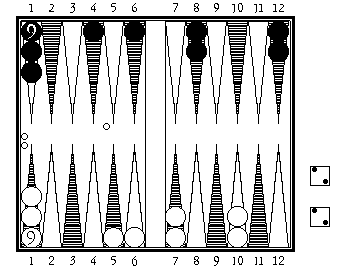 |
Finally, some scoring! With five-two, Cloris is able the
single checker on Damon's six point from her coin. She scores
four points by moving one of the small markers along her side of the
board. She then makes the eight point with checkers from her three and
six points. The play, scoring and checker movement involve many
new ideas detailed below. |
Dames Battues (hitting a blot)
Hitting a blot is known as
battre sur une demi-case or sometimes jans de recompense. It is the
most basic scoring play in trictrac. You can only hit single checkers. You can hit an
opponent's blot with a single die or with the sum of both dice. To hit with the sum, one
of the intermediate points must be free. For example, if Damon had a blot on his four
point in the diagram above, Cloris would not be able to hit with a six-three, as both
the seven and ten points are blocked. This is known as battre a faux and is
actually worth points to Damon. Cloris could hit with a five-four.
Scoring for
Dames Battues
The score for hitting blots depends on the location of
the opponent's checker (petit or grand jan), whether the the throw was
doubles (par doublet) or not (par simple) and how many ways the blot was
hit. Hitting a blot in the opponent's petit jan (points one through six) is four
points each way par simple up to three ways (one for each die and one for the
sum). It is worth six points each way par doublet up to two ways.
Hitting a blot in the grand jan (points seven through twelve) is worth
two points each way without doubles and four each way with doubles. We don't need to
worry about the other tables in the jeu ordinaire.
Jetons de
Bredouille
You have undoubtedly wondered about the three small circles on
the left side of the board. Recall that trictrac consists of twelve games of twelve points.
The markers are used to keep score of each game. They are called the jetons de
bredouille, literally the markers of "empty-handedness." A marker
between the second and third points indicates a score of two, between the fourth and
fifth points, four. A marker is moved to the left of the center bar to indicate six and
to the right for eight. Ten points are marked at the extreme right of the board.
If a player wins the game with twelve points in a row, the player scores a
partie bredouille and wins two games. Otherwise the player wins a
partie simple or single game. A player can win a partie bredouille
by scoring the first twelve points. The second to score can win a partie
bredouille by scoring twelve consecutive points after the first player scores.
Suppose Cloris scores two points then Damon scores two. Cloris can no longer win
a double game. If Cloris scores next, Damon can no longer win a double game.
The
jetons are used to keep track of score and the possibility of a double
game. The first player to score uses a single jeton to mark the score. If the
second player scores before the first player reaches twelve, he uses two jetons
to mark the score. Then, if the first player scores before the second reaches twelve, he
removes one of the two jetons that mark the opponent's score.
Checker
Movement
Cloris will not actually move a checker from her coin to Damon's six point. In
trictrac we distinguish between mouvements effectifs and mouvements par
puissance. Mouvements effectifs are actual movements of checkers
corresponding to numbers thrown on the dice. A player can only hit a blot par
puissance meaning that the player rolls a number which equals the number of
points to the blot, but does not (in fact cannot) make the play. Many of the scoring
plays are par puissance.
|
(diagram repeated for convenience) After Cloris scores four points
for hitting on the six point, she moves to checkers to the eight point.
Damon rolls two-two. |
Continue
Feedback?
The Trictrac Home Page